
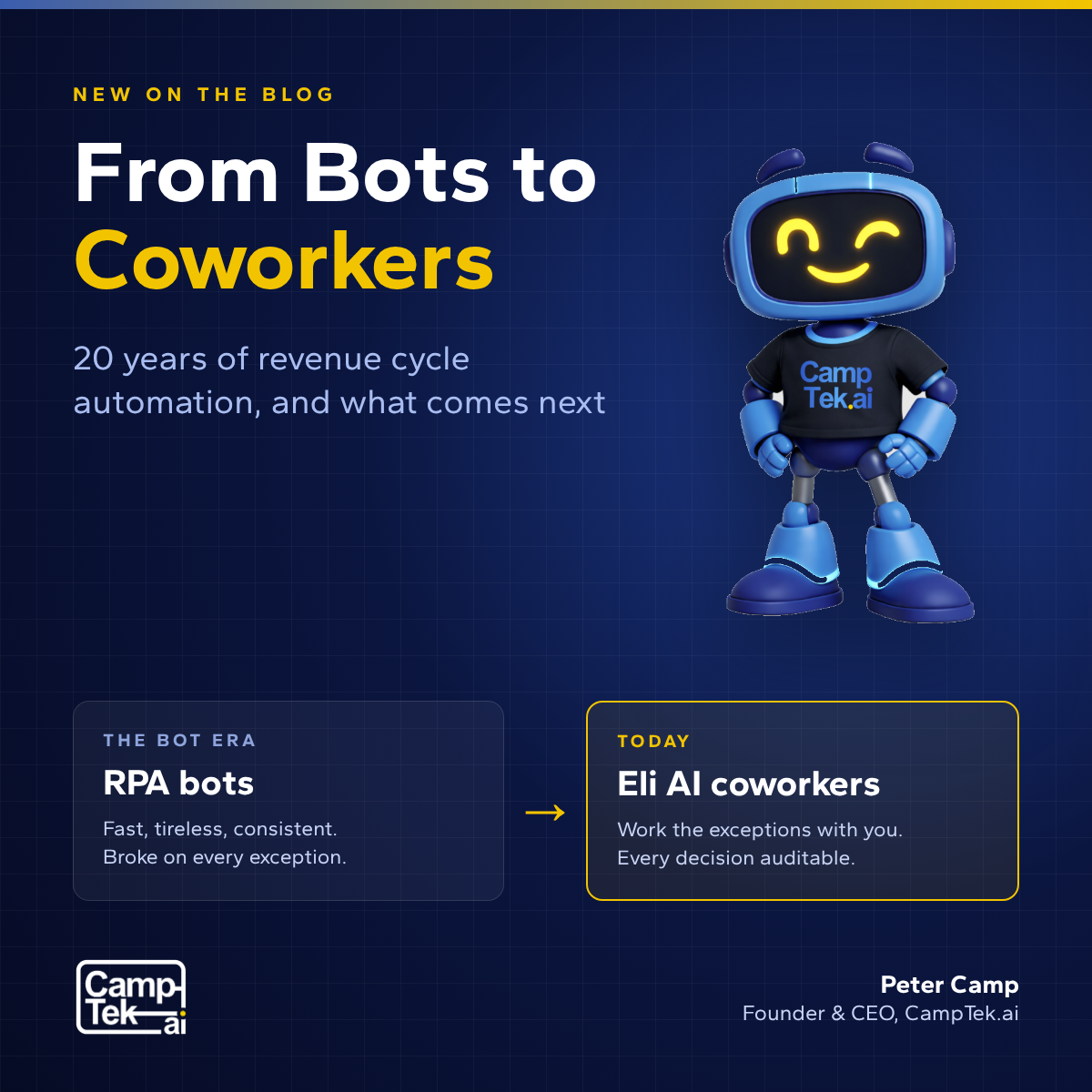
I’ve spent more than 20 years in the revenue cycle, and most of them trying to take the drudgery out of it. I’ve watched every wave of automation promise to fix healthcare billing. Some delivered. Most delivered less than they promised.
The first bot I ever put into production worked beautifully for about three weeks. Then a payer changed one field on its portal, and a queue that was supposed to clear itself quietly piled up behind a broken script. [Add your own first-bot story here: the payer, the workflow, what broke.]
That moment taught me the lesson that shaped everything we’ve built since: in RCM, the work isn’t the hard part. The exceptions are.
The bot era: fast, tireless and brittle
Robotic process automation (RPA) was a real step forward for revenue cycle teams. CampTek became a UiPath Certified Service Network Partner because bots did things people shouldn’t have to do: check eligibility on thousands of patients overnight, post remits, and pull claim statuses from payer portals.
Bots got three things right:
- They worked around the clock without overtime.
- The same steps ran the same way every time.
- Measurable ROI. Hours saved showed up on a spreadsheet the CFO could read.
They also had a ceiling. A bot follows a script, so it can’t use judgment. When a denial arrived with an unfamiliar reason code, or a payer changed its prior auth rules, the bot stopped and a person took over. Every portal redesign meant a maintenance ticket.
Over two decades, we automated the easy 60 to 70 percent of many workflows. The remaining 30 percent, the judgment calls, is where the money is lost and where staff burn out.
What changed: AI can finally handle the exceptions
Modern AI changes the problem. Today’s models can read a denial letter, understand what the payer is asking for, draft an appeal, and decide what to do next. For the first time, software can work on the judgment-heavy 30 percent and not only the scripted 70.
That said, there’s a gap between what the press releases say and what happens on the floor. Almost every RCM vendor now calls itself “AI-powered.” Yet denial rates are still climbing and prior auth backlogs haven’t gone away.
The reason is simple. A general-purpose model knows a lot about medicine and nothing about how your payers behave. It doesn’t know that one regional plan always denies a certain CPT code on the first pass, or that your senior biller has a workaround nobody wrote down. Better AI alone isn’t enough. It also needs to know the business.
From bots to coworkers: why we built Eli
We built Eli because our customers didn’t need another platform to migrate to, or another outsourcer to hand their work to. They needed more capacity from people who already knew the job.
Eli is a team of AI coworkers, each focused on one revenue cycle workflow:
- Denials & Appeals: reads the denial, finds the root cause, and drafts the appeal.
- Prior Authorization: gathers the clinical documentation and tracks each request to a decision.
- Insurance Eligibility: verifies coverage before the patient arrives.
- Claims Submission and Follow-up: gets clean claims out the door and chases the ones that stall.
A coworker works alongside your staff, not around them. Eli takes the volume and the repetitive judgment calls. Your team handles the cases that need a human relationship or a clinical conversation. Every action Eli takes is logged and traceable, so a manager can see what it did on any claim and why.
Eli also builds on the automation our customers already run. Existing bots keep working, Eli handles the exceptions they used to drop, and it connects to clearinghouses and payer networks like Waystar, Availity and eviCore.
Twenty years of exceptions is the advantage
Anyone can call a large language model today. What they can’t easily copy is two decades of watching where revenue cycle workflows break. Eli is built on that knowledge in four ways:
- Capturing tribal knowledge. The workarounds your best billers carry in their heads become rules Eli follows and shares across the team.
- Payer-specific models. Eli uses smaller models tuned to how individual payers actually behave, not just a general model guessing.
- A data flywheel. Every denial worked and every appeal won makes Eli better at the next one. The value compounds over time.
- Fits your existing stack. Eli works within the systems you already have, without depending on a single EHR vendor’s roadmap.
The bots taught us where the exceptions are. Eli is built to handle them.
What I’d tell any revenue cycle leader today
If you’re evaluating AI for your revenue cycle, these are the questions I’d ask any vendor, including us:
- What happens on the exceptions? Ask them to demo a messy denial, not a clean one.
- Can I see why it made each decision? If it isn’t auditable, it isn’t ready for healthcare.
- Does it learn my payers, or just payers in general?
- What do I have to rip out to use it? The best AI fits the systems you already run.
- Who does my team become? The right answer is “more capable,” not “smaller.”
Twenty years ago, I thought automation was about replacing keystrokes. Now I know it’s about giving good people time back for the work only they can do. The bots were the first chapter. Coworkers are the next one.
If you want to see Eli working a live denial, I’d be glad to show you. Reach out to me directly or visit camptek.ai.


